Lund is accelerating both nationally and internationally with pilot tests and inclusive mobility.
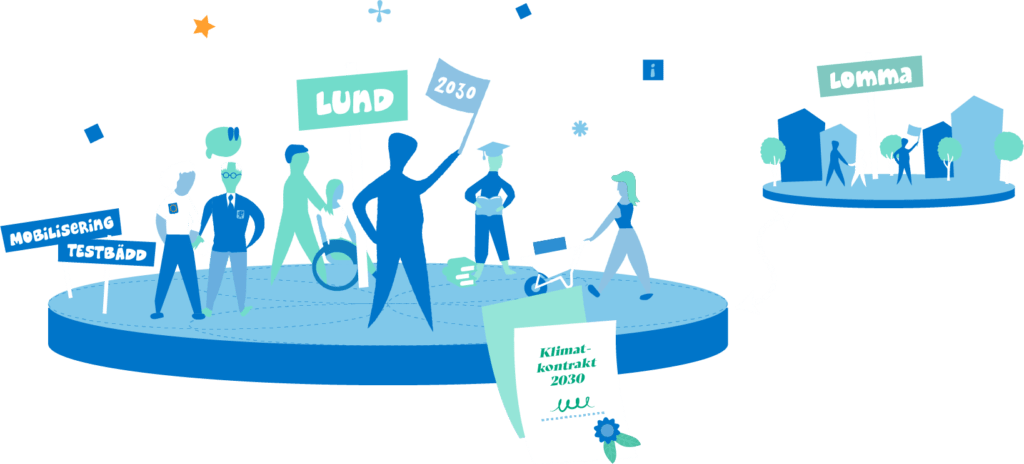
Lund hooks arms with Lomma.
Lund Municipality continues to focus on mobilizing and strengthening collaboration both internally within the municipal organization and externally by involving business, associations, universities, and municipal residents so that we can achieve climate neutrality by 2030.
The financing perspective has been highlighted more clearly during the year, not least during the Transition Lab Forum that took place in Lund in the spring. By continuing to work on the climate investment plan and exploring new innovative financing solutions, understanding and knowledge of the costs of climate transition are increasing, both in terms of investments and reprioritizations, but also in terms of the costs the municipality incurs by not acting. As part of this work, a climate budget is being drawn up with activities, costs, potential CO2 effects, other effects, target groups, and implementers. The climate budget will form the basis for decisions in the 2027 goal and budget process.
Exchanges between cities, both nationally and internationally, continue to be an important part of learning from each other and scaling up solutions. Within the EU, Lund is one of just over a hundred selected cities that will lead the way towards climate neutrality. During the year, Lund's climate work has been reviewed by experts within the EU and approved by the European Commission. We have been awarded the Mission Label, which shows that we are on the right track and gives us access to financial resources, networks, and expertise within the EU. With the Mission Label behind us, we are now entering the next phase of our climate work: implementing the climate action plan approved by the EU. Specifically, the plan comprises 37 measures divided into six key areas of transition: mobility and transport, agriculture and sustainable land use, circular economy and sustainable consumption, circular construction, energy, and carbon sinks. At the national level, Lund has gained a twin city in Lomma, where the focus is on mutual learning, but also on joint efforts in areas such as mobility and carbon sinks.
Lund's program for ecological sustainability, LundaEko, which is valid until 2030 and covers the entire municipality of Lund, was revised and adopted by the municipal council during the year. Several targets have been tightened in the updated program. Consumption-based emissions are to be reduced from 6 to 1 ton per person by 2050, with a 50% reduction by 2030. Another important target is that no more than 25 percent of car journeys within the municipality may be made by car, compared with 32 percent previously. Climate adaptation has also been given greater focus, with increased efforts to strengthen protection against extreme weather, create more wetlands and recreational areas, and promote biodiversity.
In the city's latest update, they talk about the work, the transition arena, the project portfolio and much more.


Juliet Leonette, Process Manager for Climate Neutral Lund 2030, juliet.leonette@lund.se
Simon Svendler
process manager for Climate Neutral Lund 2030,
simon.svendler@lund.se
Madeleine Wahlund, (on leave)
process manager for Climate Neutral Lund 2030, madeleine.wahlund@lund.se

Lund is home to the world's largest low-temperature, fossil-free district heating network. The MAX IV laboratory and the ESS research facility heat the city using residual heat. The aim is for other parts of Lund to also receive low-temperature heat in the networks in the future. Then Lund can grow without increasing emissions from district heating!
Lund highlights five additional initiatives that they believe may be of particular interest to other municipalities to spy and apply. Contact the process leader to spy and apply.
Every year the municipality and Lund University organize Sustainability Week - a week filled with events around Lund, free and open to all.
Lund recently developed a plan for climate-neutral construction.
Work has been done on new wetland in Södra Sandby, which reduces the risk of flooding in the area and contributes to increased biodiversity.
In Brunnshög there is an innovative waste vacuum cleanerwhich eliminates the need for heavy garbage trucks in the area, pests and bad odors.
Climate City Contract 2030 is a collective effort to achieve the climate transition that we need to implement in a short time to keep global warming below 1.5 degrees. It is an agreement between municipalities, government agencies and Viable Cities where all parties undertake to make a concrete contribution to increasing the pace of climate change.
To achieve deep change, we need to move from fragmented projects to an ecosystem of efforts that all pull in the same direction. Cities are doing this together with Viable Cities, funders government agencies and other partners, in different constellations and with different objectives. It is about moving beyond dealing with symptoms and instead focusing on underlying problems in our social structure. Here you will find the initiatives and studies within the city that have been granted funding under Viable Cities.

In one of Sweden's most workplace-dense areas with a lot of traffic, Lund, together with a number of co-actors, will create a mobility system with reduced emissions while maintaining accessibility. The mobility system will also be linked to a local climate-neutral energy system in the area where energy...

Increased digitization makes cities increasingly vulnerable to cyber attacks, where computers are compromised by malicious actors in order to cause...

The aim of the study is to introduce methods in the municipality's regular decision-making processes that clarify climate-related benefits in a way that guides investment decisions,...
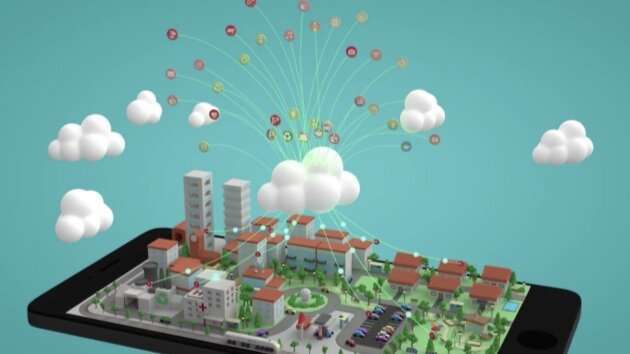
City as a Platform is an innovation initiative that brings together 18 municipalities to explore, test, implement and collaborate on common IoT platforms...

Achieving climate goals requires digital solutions, but as digitalization increases, cities are more vulnerable to cyberattacks. In order to...
The initiative will investigate the conditions for a demonstration project for flexible energy systems in buildings based on solar power, local storage and controllable loads...
The initiative will create the conditions for various companies, associations, research and public activities to benefit from open data from the energy system...

Since 2023, Lund is part of the Urban Transitions Mission (UTM) cohort of cities working together to test and scale up innovative solutions for a holistic, human-centered climate transition.
Since 2023, Lund is also part of the second cohort of pilot cities from twenty-one EU countries and Horizon 2020 associated countries, selected to launch unprecedented climate action, through the NetZeroCities Pilot Cities program.
Since 2023, Lund is part of the NetZeroCities Twinning program, where Lund is paired with Leuven, Belgium.
Lund is part of the NetZeroCities 112 Mission Cities, selected since 2022 to pioneer the EU Cities Mission.
Copyright © 2024 Viable Cities | Website policy | Accessibility