2025
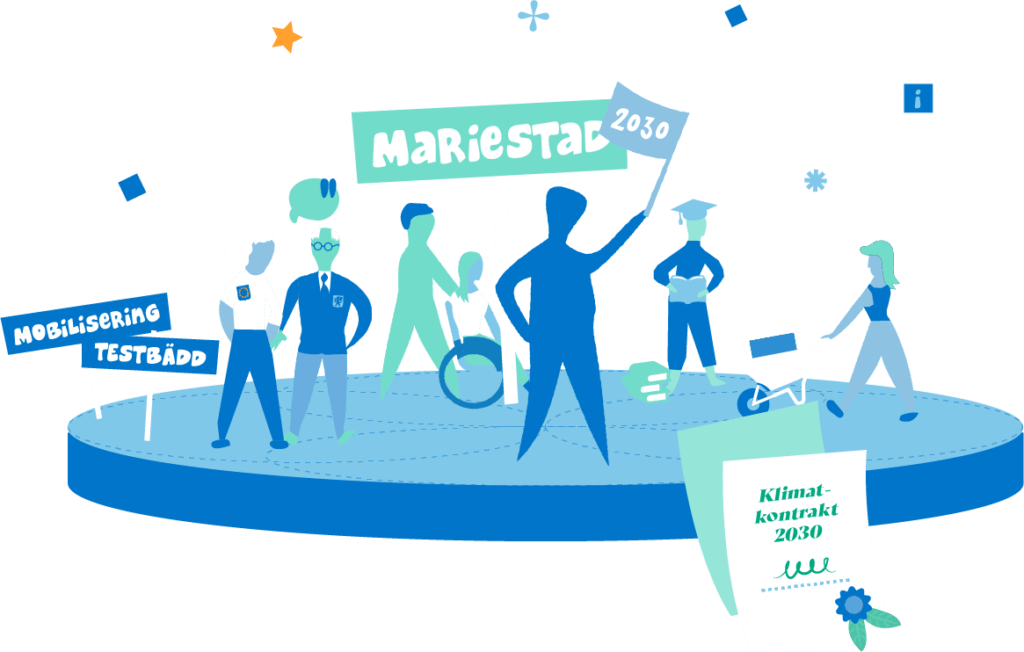
Digital tools for urban development. Students from Vadsbo High School have tested a 3D prototype of central Mariestad. The prototype, which is also based on game psychology, facilitates exploration of the city, testing of ideas, and discussion of sustainable solutions. Researchers from game colleges and universities have participated in the project and contributed their expertise. The aim is to increase participation and improve dialogue with young people and other citizens.
Resident involvement. The municipality collaborates with associations and other actors to engage residents, for example through Bike Saturday, Preparedness Week, and the Culture and Harvest Festival. The aim is to increase citizens' understanding, participation, and responsibility in climate change.
In 2025, several activities within Climate Neutral Mariestad 2030 have been able to coordinate benefits for climate change, public health, and traffic safety, including the following.
Testing sustainable travel with folding bikes. In collaboration with Västtrafik, residents were given the opportunity to test folding bikes that can easily be taken on buses and trains free of charge for four weeks. Participants also received a Västtrafik card, which made it easier to replace car journeys with a combination of bicycle and public transport. The test showed how flexible travel options can lower the barriers to more sustainable travel.
The Bike Campaign for more children walking or cycling to school. The Bike Campaign engaged the municipality's middle schools in a competition with the goal of increasing the proportion of children walking or cycling to school. During the fall, more than 400 students participated, walking and cycling a total of nearly 1,500 miles, which is equivalent to the distance from Mariestad to Madrid and back twice. The competition is part of a joint effort by the municipality and NTF to identify measures needed to increase traffic safety, such as training in safe cycling, information for guardians, and investments in the bicycle network.
The benefits of trees in the city became a walking trail. To highlight the important role of trees in the city, the municipality created a walking trail featuring selected trees. Through signs and digital information, visitors can learn how much carbon dioxide each tree absorbs per year, how much oxygen it produces, and the total climate benefit the tree has contributed during its lifetime. The information is put into relation to the corresponding emissions from car or train travel, making the walk both a nature experience and an eye-opener to the city's green values.
2024
Mariestad highlights two initiatives that they believe could be of particular interest to other municipalities to spy and apply. Contact the process leader to spy and apply.
- The Mariestad Climate Game
The Mariestad Climate Game is a board game where the player can practice making Mariestad climate neutral over seven years. The hope is that the game will spread knowledge about how the climate transition can work and inspire and arouse curiosity about the subject. The climate game shows how a sustainable society can be built, but also some of the challenges that may arise along the way, and can be found at schools and study associations and can be borrowed from the library. - Kronoparkens preschool with hydrogen
Kronoparkens preschool is perhaps the first preschool in Sweden to be able to be virtually disconnected from the local electricity grid. Solar cells on the roof produce electricity for the preschool and the surplus will be stored in the form of hydrogen, which is then used for operation and heating during the winter months. The investment is part of Mariestad municipality's future investments in the transition to a fossil-free and sustainable society. It also gives children the chance to understand early on the importance of sustainability that permeates the environment and pedagogy at the preschool.