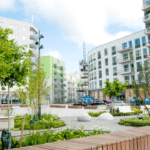



Purification of sulphide clay. As part of the Stockholm Agreement, Järfälla is building 14,000 new homes by 2035. Construction also generates excavated material, which needs to be handled intelligently. In 2024, a mass management strategy was developed with the aim of minimising the generation of waste and increasing the reuse of excavated material. This will reduce the amount of waste and greenhouse gas emissions, lower transport and purchasing costs for new fill material, and ensure a secure supply of materials. One of the measures implemented to reduce the amount of surplus material is that the municipality has tested new technology for purifying sulfide-containing material. This has significantly reduced the amount of sulfide clay that would otherwise have been sent to landfill. Instead, the sulfide clay has been converted into topsoil that can be recycled and used in planting.
Climate assessment of new master plan. In recent years, intensive work has been underway to develop a new master plan for Järfälla. The master plan is one of Järfälla's most important policy documents and sets out the long-term vision for how the municipality's land and water resources are to be used, preserved, and developed. To ensure that Järfälla's ambitious climate goals are taken into account, the municipality chose to carry out a climate calculation of various plan alternatives. The climate calculation aimed to facilitate trade-offs between different types of development scenarios and highlight the climate impact of different decisions. With the help of the consulting firm Spacescape, a climate calculation was carried out for four development scenarios: Zero Alternative, Circular, Densification, and New Construction. The calculations were based on a large amount of data, and the diagram shows a summary of the four development scenarios examined and their emissions:

The "New Construction" option has 2.5 times higher climate emissions compared to the circular plan option, which focuses instead on renovating and converting existing properties. The additional space required for the construction of new buildings is the single most important explanation for the large differences in total climate emissions. Materials, distance to services, project start time, and changes in land use also affect the size of emissions.
Several planning exercises were also carried out as part of the climate calculation. The exercises showed, for example, that Järfälla could reduce its net carbon dioxide emissions by up to 30 percent by building exclusively with wood. The following measures are considered to have a particularly significant impact on Järfälla's efforts to reduce climate emissions from urban development:
The climate calculation has formed the basis for the development of the final draft plan for Järfälla's comprehensive plan.
The city is currently working on collecting good examples of how they mobilize and work for the climate transition. They will be here soon!