




Green Travel Plans

Most of the trips we take are short and routine: to work, to school, or to the gym. When more people walk, bike, or take public transportation, everyone in society benefits: people feel better, workplaces have healthier employees, society can avoid costly infrastructure projects, and carbon dioxide emissions are reduced.

Green Travel Plans are a collaborative initiative that uses incentives and smart measures to make it easier to travel sustainably in everyday life.

A journey that benefits us all

More sustainable daily trips to work, school, leisure activities, and
for everyday errands have a greater impact on the community than we might think.

Lower emissions – trip by trip

When more everyday trips are made in a sustainable way, the environmental impact decreases rapidly.

Less congestion – smoother traffic flow

When more people choose sustainable travel, traffic congestion decreases—and daily life runs more smoothly for everyone.

More money left over for other things

Changing travel habits is a cost-effective complement to building new infrastructure.

Healthier residents

More active travel improves well-being while reducing the number of sick days and the burden on the healthcare system.

More vibrant places

Sustainable travel helps create more attractive places—places where people want to be.

The Journey We Share

Our daily commutes matter

Green travel plans are a practical approach to creating more climate-smart communities, while also simplifying the daily commute, making cities safer and more accessible, and making workplaces more attractive—right here, right now.

Here you’ll find resources to help you get started with Green Travel Plans in your community. You’ll learn more about the benefits they offer, the process for getting started and implementing the initiative, and how others are already doing it.

Tips for getting started

Implementing Green Travel Plans doesn’t require building new subway lines or imposing sweeping car bans. Change starts with small steps.

Start simple, but start for real

Choose a clear starting point: a workplace, a school, a defined area, a challenge in the current transportation system, or a small group of committed stakeholders.
Set an initial, realistic milestone. An example: “25 percent of car commuters will try cycling for four weeks by offering bike commuting as work time.”
Plan for measures that can actually be implemented within a few months.

Make the supply chain transparent
– every step of the way

Quickly map out the entire journey from door to door. Where does the friction occur: Is the last stretch from the stop unsafe or difficult? Is there a lack of secure bike parking? Is the choice of travel affected by drop-off and pick-up times or by the children’s after-school activities?
When the travel chain is visualized, it becomes easier to see where the weakest link is—and which measures can actually make a difference and which stakeholders need to collaborate.

Choose 2–3 steps that will make things easier right now

Focus on a small range of both “soft” and “concrete” measures.
This could involve combining a trial offer with measures to facilitate carpooling and making a simple on-site improvement, such as bike racks or shower facilities.
When people notice a difference in their daily lives, it becomes easier to build engagement and take the next step.

The social context as a driving force

It is people themselves who are changing their travel habits, every day, through the transportation choices they make. Already, many people are walking, biking, taking public transportation, or carpooling.

Green travel plans reach people in their daily lives and within their social circles—with coworkers, neighbors, friends at school, in community groups, and on sports teams. When change happens together, motivation increases, and it becomes easier to both start and continue traveling sustainably. 

Green travel plans serve as a tool that brings stakeholders together and translates collaboration into concrete, practical actions. By working with the organizations and stakeholders that make up our social networks, we can accelerate behavioral change and shift norms regarding how everyday travel should take place. When multiple stakeholders collaborate, change becomes both faster and more sustainable. 

Daily Commuting – An Opportunity to Reduce Emissions

Emissions from domestic transportation account for just over one-third of Sweden’s total greenhouse gas emissions. Road traffic accounts for the largest share, with passenger cars accounting for approximately 20% of those emissions.

By comparison, emissions from electricity and district heating production accounted for about 8 percent of Sweden’s total emissions in 2024.

At the same time, national travel surveys show that everyday travel is widespread. How we choose to get to work, school, and other activities every day therefore plays a significant role in our ability to reduce emissions.

“These days, I often choose to take the train instead of driving, since it’s cheaper for me than gas, and parking fees are high. The fact that I can work on the train at the same time gives me even more motivation to take the train more often.”
Emil Ed
Energy Opticon in Lund

Collaboration is key

A crucial aspect of the work on Green Travel Plans is collaboration among various stakeholders. Which stakeholders need to be involved depends on the specific area or activity the plan focuses on. However, regardless of the focus, the goal is to bring together stakeholders who have the authority to make decisions, influence over travel and travel habits, and the ability to implement concrete measures.

In addition to municipalities and regional authorities, property owners and employers are often key players, as they can both influence the conditions and engage people in the change process.

Factors that influence how we travel in our daily lives

The Municipality as an Urban Planner

Officials in the fields of urban planning, transportation, climate, the environment, business communications influence how the city is planned and how the transportation system is developed.

The municipality as an operator and property owner

Many daily trips are made to preschools, schools, libraries, sports facilities, and other municipal services.

The municipality as an employer

In many municipalities, the local government is the largest employer. Influencing the travel habits of municipal employees can therefore have a significant impact.

Private employers

Can influence both the conditions and incentives for how their employees travel.

Property owner

Can create better opportunities for sustainable travel for tenants and customers, for example through bike parking or mobility solutions.

Mobility providers

Offers mobility services such as public transportation, car-sharing, and bike-sharing.

Clubs

Community organizations run programs that many residents—both children and adults—attend several times a week. 

Other stakeholders

For example, parking companies, the police, and nonprofit organizations such as NTF or Cykelfrämjandet.

This is how others have done it

Many Lund-based companies have green travel plans

Thousands of employees in Lund are participating in a green travel plan. Collaboration and a shared commitment are driving the Green Travel Plans initiative within the CoAction Lund partnership platform, which currently includes around 30 organizations with 40,000 employees in the city.
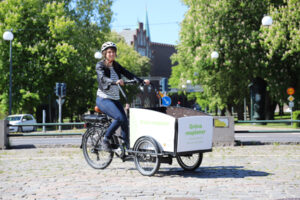

Woman with a cargo bike in Linköping

Linköping is reducing traffic congestion—without building more roads

When traffic congestion increases, it’s easy to assume that the solution must be new pavement. Linköping chose a different path. By adopting green travel plans as a long-term, flexible approach, the city has been able to direct its efforts where they are most effective and adapt them over time.

Autumn in Östersund

Support for businesses leads to greener travel

In Östersund, sustainable travel is linked to social sustainability and individual motivations through the use of behavioral design. Instead of waiting for new bike lanes or street renovations, they have developed a method to bring about change immediately.

Start your journey!

Several Swedish municipalities are already working on Green Travel Plans in various ways. The materials on this website are designed to make it easier to get started and to adapt the process to your local conditions.

About this page

The summary of the “Green Travel Plans” approach presented here is the result of a collaboration in 2025 between Viable Cities, SKR (Swedish Association of Local Authorities and Regions), the City of Linköping, and a dozen Swedish municipalities as part of the Climate-Neutral Cities 2030 initiative, with the aim of facilitating, deepening knowledge of, and accelerating and broadening the implementation of the approach in the municipalities. The work was carried out in 2025 with funding from Vinnova as a feasibility study to prototype an accelerator designed to support the implementation, scaling, and dissemination of Green Travel Plans and other successful initiatives for climate-neutral and sustainable cities at the local level.

The City of Linköping, which has been working with Green Travel Plans since 2013, is a pioneer among municipalities and has inspired a number of other municipalities to launch similar initiatives, not least Lund and Östersund. Twelve cities at various stages of implementing Green Travel Plans have participated in the work and shared experiences and insights, concrete tools, methods, and documents with one another and with the project. These have been collected and compiled to inspire and guide other cities and their local stakeholders in their joint efforts to implement and further develop Green Travel Plans. Implementing green travel plans contributes to reducing climate emissions and a range of other positive effects, such as smoother daily travel, better accessibility, improved public health, inclusion, and gender equality. Evaluations of travel to areas with green travel plans show, among other things, reduced congestion and lower climate emissions over time. The travel plans have also created a clear forum for dialogue on sustainable transportation with employees, employers, and property owners.

To support the implementation, dissemination, and scaling of new working methods, knowledge resources such as guides, descriptions, and tools are needed. A key insight is that the value of these resources increases significantly when combined with opportunities to meet, discuss, and learn together with others who are working to implement similar working methods.

Viable Cities Logo

Cycling instead of driving: a concrete example

Imagine five medium-sized workplaces, each with 100 employees. If 200 people currently drive to work and 30% try switching to a different mode of transportation—and half of them then continue to bike—we’ll have 30 people biking instead of driving.

If each person had otherwise commuted by car 12 km per day and cycling replaces the car trip, this could result in a reduction of approximately:

CO2 emissions per workday (30 × 2.58 kg)
- 0 kg
Annual CO2 emissions (250 working days)
- 0 kg
CO2 emissions over five years
- 0 tons