
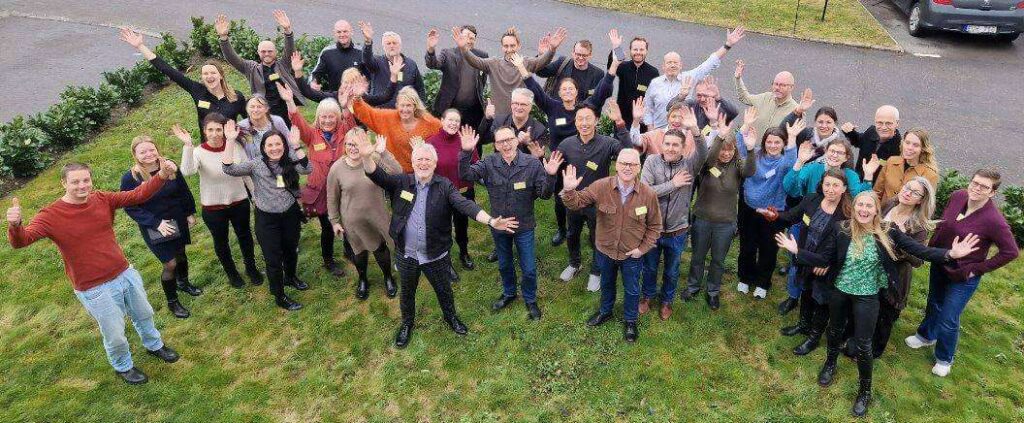
Thirty organizations with 40,000 employees are working on Green Travel Plans through the CoAction Lund collaboration platform. Collaboration and a shared commitment give momentum to the effort.
The City of Lund is one of approximately thirty partners in CoAction Lund, a system demonstrator and platform for collaboration between the public, private, and nonprofit sectors, with a focus on energy and mobility issues. Within the framework of CoAction Lund, all partners have committed to developing their own Green Travel Plan and implementing at least five measures to promote sustainable commuting to work or on business for their employees. Together, the partners represent approximately 40,000 employees.
In the fall of 2024, all partners in CoAction Lund conducted a travel behavior survey. The results provided concrete evidence of which initiatives are in demand and which should be prioritized, and each partner has developed its own green travel plan. With clear coordination, travel behavior data, and a mix of measures, the partners have been working on their initiatives throughout 2025. Workplaces and employee groups have been involved through workshops and encouraged to develop a green travel plan or measures at the unit level. This opens the door to more workplace- and operation-specific measures. By getting more employees involved, helping them explore and try alternative modes of transportation to the car, the initiative yields clear benefits in employees’ daily commutes.
At the same time, the partners collaborate in groups on cross-organizational issues, such as parking, bicycle infrastructure, and shared mobility solutions, to jointly improve the practical conditions so that making sustainable choices not only feels good but also becomes easier. A concrete example of the results of this collaboration is that Lund’s first hub forLundahoj bike-sharing has been established on private land, with TetraPak providing space for a hub for employees and Lund residents.
As one of Lund’s largest employers, the municipality’s role as an employer is crucial. In Lund Municipality’s own green travel plan, initiatives such as competitions, electric bike rentals, and improved bike parking facilities have fostered employee engagement, yielding measurable results.
The City of Lund demonstrates that Green Travel Plans work best when they combine:
This means that the work does not stop at individual initiatives, but instead becomes an approach in which the actions of various stakeholders can be combined and built upon.
Employees are encouraged to participate in a sustainable travel challenge, complete with prizes and a group wrap-up party. This initiative generates enthusiasm and conversation within the organization and lowers the barriers to trying new modes of travel. The group party afterward celebrates successes, fosters a sense of community, and creates visibility and a desire for more people to join in.
The municipality is launching an e-bike rental program for everyone. The word is spreading internally, and even the municipality’s own employees are taking the opportunity to try them out, demonstrating in practice that a trial ride can be the catalyst that helps new travel habits take hold. As more people try them, they also become natural ambassadors who help others choose e-bikes.
The municipality is updating its design guidelines for bicycle parking facilities to include stricter requirements for new construction and major renovations. The new requirements ensure safer, more theft-resistant bicycle parking facilities and make weather protection a standard consideration in every project.
The idea of a bike-sharing station on privately owned land came from CoAction Lund. When the municipality explained the difficulties of finding space for bike-sharing stations on public land or street property, TetraPak saw an opportunity to make things easier for its employees and the residents of Lund by making parts of its land available for a more extensive network of bike-sharing stations in the city.
Employers are responsible for sharing information about these efforts with their employees to foster engagement within their own organizations. Internal communication is strengthened through news and articles, as well as tips and practical information on sustainable travel.
Several companies now offer public transportation passes as an employee benefit.
The CoAction Lund collaboration forum meets several times a year, and more members are joining. In 2026, the two focus areas of mobility and energy were joined by the new initiative, CoAction Bygg.
The work on the municipal organization’s own green roadmap is coordinated by a coordinator and a working group, as well as through ongoing dialogue with environmental coordinators in the relevant departments, which ensures both buy-in and momentum in the implementation. The work is monitored through regular check-ins, clear coordination, and active support for the departments. The City of Lund also highlights the benefits and effects of the measures—such as improved health, well-being, traffic safety, and reduced sick leave—that many can agree on over time.
Greater engagement and better understanding of sustainable commuting to work and while on the job.

A successful competition that fosters motivation and a sense of community within the organization.
Growing interest in electric bikes through rental programs is lowering the barriers to entry.

The summary of the “Green Travel Plans” approach presented here is the result of a collaboration in 2025 between Viable Cities, SKR (Swedish Association of Local Authorities and Regions), the City of Linköping, and a dozen Swedish municipalities as part of the Climate-Neutral Cities 2030 initiative, with the aim of facilitating, deepening knowledge of, and accelerating and broadening the implementation of the approach in the municipalities. The work was carried out in 2025 with funding from Vinnova as a feasibility study to prototype an accelerator designed to support the implementation, scaling, and dissemination of Green Travel Plans and other successful initiatives for climate-neutral and sustainable cities at the local level.
The City of Linköping, which has been working with Green Travel Plans since 2013, is a pioneer among municipalities and has inspired a number of other municipalities to launch similar initiatives, not least Lund and Östersund. Twelve cities at various stages of implementing Green Travel Plans have participated in the work and shared experiences and insights, concrete tools, methods, and documents with one another and with the project. These have been collected and compiled to inspire and guide other cities and their local stakeholders in their joint efforts to implement and further develop Green Travel Plans. Implementing green travel plans contributes to reducing climate emissions and a range of other positive effects, such as smoother daily travel, better accessibility, improved public health, inclusion, and gender equality. Evaluations of travel to areas with green travel plans show, among other things, reduced congestion and lower climate emissions over time. The travel plans have also created a clear forum for dialogue on sustainable transportation with employees, employers, and property owners.
To support the implementation, dissemination, and scaling of new working methods, knowledge resources such as guides, descriptions, and tools are needed. A key insight is that the value of these resources increases significantly when combined with opportunities to meet, discuss, and learn together with others who are working to implement similar working methods.


Viable Cities is a strategic innovation program with the mission of achieving climate-neutral cities by 2030, ensuring a good quality of life for all within the planet’s limits. The program is funded by the Swedish Energy Agency, Vinnova and Formas and coordinated by KTH.

Copyright © 2024 Viable Cities | Website Policy | Accessibility