
Green travel plans as a methodology and concept are relatively new, but efforts to promote sustainable travel have been underway for a long time and in many places. As a result, there is a wealth of experience, lessons learned, and research to draw upon. Here we have compiled a selection of these.
The report by Afry/Sweco compiles best practices on how car-free zones around schools can be designed and what effects they can have—both in Sweden and internationally. The aim is to serve as a practical resource for municipalities and officials, particularly given the lack of uniform guidelines in Sweden. Car-free zones can contribute to increased traffic safety and make it easier for more students to walk or bike to school. For the change to be sustainable over time, efforts must be combined: physical measures such as safe walking and biking paths and clear drop-off/pick-up solutions, together with behavior-changing initiatives such as communication, campaigns, and trial activities. Here, the role of school staff is particularly important—they are a credible source and the key to reaching students and parents with messages that work in everyday life.
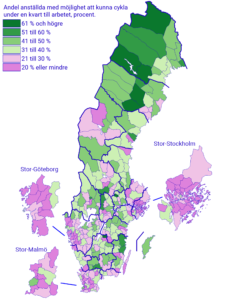
This analysis from Statistics Sweden examines the conditions for the “15-minute city” in different parts of Sweden and in various municipalities. Nearly 1.2 million of the country’s employees have the option of cycling to work in less than 15 minutes, based on the distance between their home and workplace. This corresponds to one-third of those who are employed. The best conditions for cycling to work are often found in outlying municipalities with few urban centers, where a large proportion of residents live in the main town, meaning that even sparsely populated municipalities often have favorable conditions. Jobs in healthcare and social services are often located in urban centers, which contributes to more women than men having a short distance to cycle to work.
Here you will also find links to statistics by municipality and the regional classification DeSO (Demographic Statistical Areas).
The report *Evaluation of the Health Effects of Active Transportation with Improved Walking and Cycling Infrastructure* (2024) was prepared by Ramboll on behalf of the Swedish Transport Administration. It provides a comprehensive and clear overview of the current state of knowledge regarding the health effects associated with active transportation.
The literature review shows that increasing physical activity in daily life—through walking and cycling—can help reduce the risk of cardiovascular disease, type 2 diabetes, and certain types of cancer. It also highlights benefits such as improved mental health and reduced mortality. Overall, the report indicates that the health benefits are significant, and that initiatives that make walking and cycling easier and safer are a concrete way to improve public health.
A clear, practical guide to implementing School Streets from Hackney, London. A School Street is a road—or a section of a road—that is closed to motor vehicle traffic during school drop-off and pick-up times to create a zone reserved exclusively for pedestrians and cyclists.
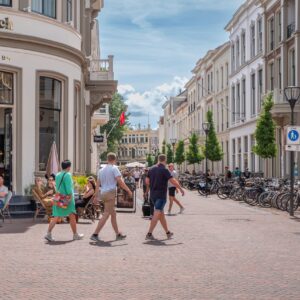
Pedestrians and cyclists contribute to vibrant urban environments by spending significantly more money in the city center than car or public transit users do, thanks to their higher frequency of visits. On a monthly basis, cyclists and pedestrians contribute approximately 25 percent more to the total amount spent in the city center than car users. They are particularly important for city centers that attract visitors from the surrounding area, residents, and workers. The results of the study are important for shaping visions and policies for city centers. Pressure on public spaces is increasing, which requires choices, especially regarding mobility. This research provides valuable insights for city center areas.
This handbook is a practical guide to leading digital dialogues on sustainable travel. The goal is to empower individuals to make changes, become ambassadors for sustainable behaviors, and thereby accelerate the climate transition by shifting the social norm from car dependency to sustainable travel. The handbook was developed as part of the GREPPET pilot study conducted in Östersund and is based on behavioral science methods.
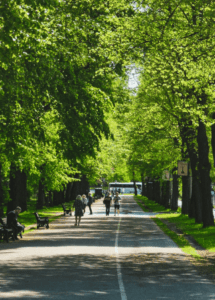
Creating school streets by making streets car-free and greener—with Paris as an example. Since the summer of 2020, the City of Paris has been working to make 300 streets car-free and greener as part of the Rues aux écoles project. In addition to increasing safety and security around schools, the streets become calmer and more pleasant places, as well as cooling green spaces in the dense urban environment. The initiative also helps reduce air pollution near schools.
This document compiles examples from European projects in which street space has been reallocated to make more room for walking and cycling. Many of these initiatives gained momentum during the COVID-19 pandemic, when cities needed to create safer, more spacious environments while reducing congestion on public transportation and dependence on private motor vehicles.
This section highlights specific examples—from Spain, Germany, the United Kingdom, Italy, and France—that demonstrate how relatively quick changes to the street environment can make it easier to travel actively and contribute to a more accessible and pleasant city.
Active School Travel is a research project led by Luleå University of Technology aimed at encouraging more children to travel to school actively. Here you’ll find tips and resources for schools to use. Useful links to research reports on the effects of active school travel on children’s health, self-esteem, and academic performance, among other things.
The SKR Methodology Guide assists both those who wish to share innovations and those who wish to use them. To help new users leverage, adapt, and adopt proven solutions in a simple and clear manner, the guide provides concrete support with the questions and steps required for successful implementation. Success requires both structure and commitment. With support in change management, digital maturity, and cost-benefit analysis, you’ll gain the tools to create long-term, sustainable results and unlock the power of sharing and using.

"On Your Own Two Feet" is a project organized by Västtrafik, in which schools in Västra Götaland, Halland County, and the municipalities of Helsingborg, Simrishamn, Eslöv, and Lund in Skåne County are invited to participate. The challenge runs during weeks 37–41 and aims to encourage children in grades 4–6 to get to school by biking, walking, or taking public transportation—instead of making short trips by car.
"On Your Own Two Feet" is structured as a points-based competition in which the class competes for great prizes, while students gain knowledge through activities focused on the environment, health, traffic safety, and sustainable development.

The summary of the “Green Travel Plans” approach presented here is the result of a collaboration in 2025 between Viable Cities, SKR (Swedish Association of Local Authorities and Regions), the City of Linköping, and a dozen Swedish municipalities as part of the Climate-Neutral Cities 2030 initiative, with the aim of facilitating, deepening knowledge of, and accelerating and broadening the implementation of the approach in the municipalities. The work was carried out in 2025 with funding from Vinnova as a feasibility study to prototype an accelerator designed to support the implementation, scaling, and dissemination of Green Travel Plans and other successful initiatives for climate-neutral and sustainable cities at the local level.
The City of Linköping, which has been working with Green Travel Plans since 2013, is a pioneer among municipalities and has inspired a number of other municipalities to launch similar initiatives, not least Lund and Östersund. Twelve cities at various stages of implementing Green Travel Plans have participated in the work and shared experiences and insights, concrete tools, methods, and documents with one another and with the project. These have been collected and compiled to inspire and guide other cities and their local stakeholders in their joint efforts to implement and further develop Green Travel Plans. Implementing green travel plans contributes to reducing climate emissions and a range of other positive effects, such as smoother daily travel, better accessibility, improved public health, inclusion, and gender equality. Evaluations of travel to areas with green travel plans show, among other things, reduced congestion and lower climate emissions over time. The travel plans have also created a clear forum for dialogue on sustainable transportation with employees, employers, and property owners.
To support the implementation, dissemination, and scaling of new working methods, knowledge resources such as guides, descriptions, and tools are needed. A key insight is that the value of these resources increases significantly when combined with opportunities to meet, discuss, and learn together with others who are working to implement similar working methods.



Viable Cities is a strategic innovation program with the mission of achieving climate-neutral cities by 2030, ensuring a good quality of life for all within the planet’s limits. The program is funded by the Swedish Energy Agency, Vinnova and Formas and coordinated by KTH.

Copyright © 2024 Viable Cities | Website Policy | Accessibility