
As traffic congestion increases, it’s easy to assume that the solution must be new pavement. Linköping chose a different path. By adopting green travel plans as a long-term, flexible approach, the city has been able to target its efforts where they are most effective and adapt them over time. New travel habits may be the smartest solution—in many ways.
Linköping’s experience shows that systematic efforts to change travel habits often yield a greater return on investment than new asphalt, but also that these solutions can be adjusted as conditions change. Green travel plans are therefore not merely a soft complement to infrastructure, but a strategic investment in their own right.
In 2018, traffic jams on the access roads had caused congestion during rush hour, and the City of Linköping faced the choice of either building new infrastructure to solve the problem or trying to reduce traffic by influencing travel patterns themselves. Eliminating congestion through infrastructure is expensive—a new roundabout can cost between 25 and 40 million kronor, and experience shows that new road capacity is often filled up again by induced traffic.
For the same budget allocation, the municipality determined that it could instead fund project managers and mobility coordinators tasked with working over the long term with employers, property owners, and public transportation providers to gradually change travel habits.
This is how much CO2 emissions from business travel by municipal employees have decreased over five years.

Increased dialogue between Östgötatrafiken and major employers
Green travel plans are now a platform for discussing sustainable travel.
Green travel plans often deliver a better return on investment than new road capacity.
When a transportation system is operating near its capacity limit, even a relatively small reduction in car traffic is enough to significantly improve traffic flow. Every car trip that can be avoided on a congested stretch of road during rush hour therefore makes a bigger difference than one might initially think.
So, instead of renovating or building new facilities, it was decided to further develop the municipality’s work on green travel plans. This initiative had actually been underway since 2015, when a green travel plan was developed for the municipality’s own employees, and was expanded in 2017 to include Linköping Science Park in Mjärdevi.
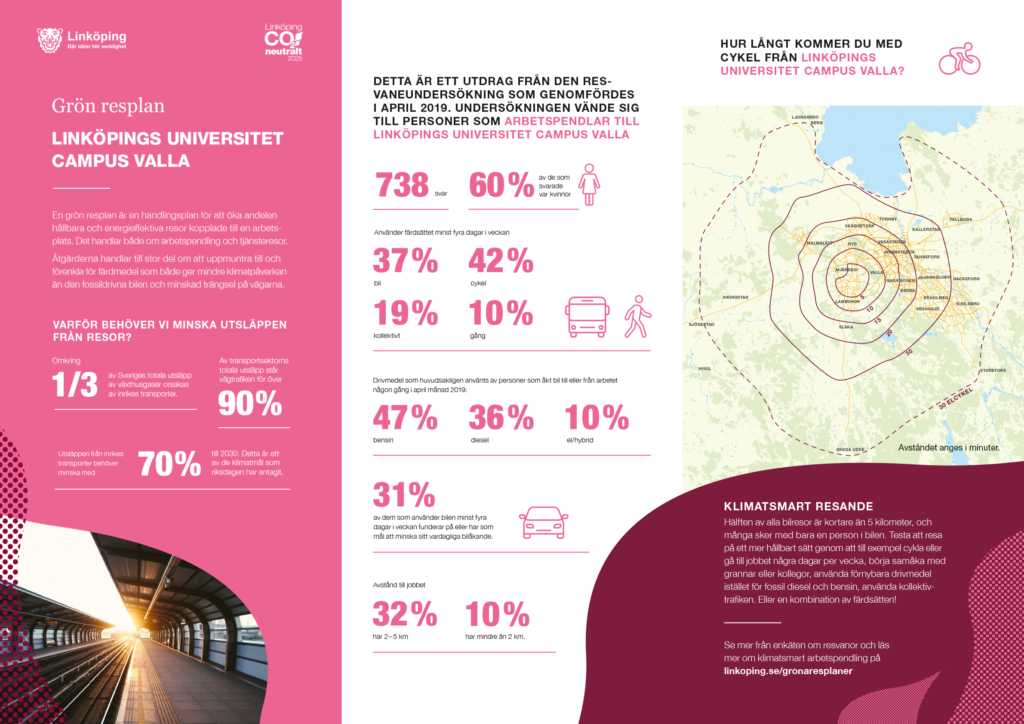
By appointing a mobility coordinator tasked with investigating, coordinating, and managing projects aimed at shifting travel habits in a new direction, the municipality—with support from the Swedish Energy Agency—developed four additional green travel plans based on four strategically selected routes where many commuters passed through the city’s most congested areas during rush hour.
The initiative was launched and planned by the municipality, but was carried out in close collaboration with property owners, employers, and the regional public transit authority. The focus thus shifted from building more roads to using existing resources more intelligently. As a result, Green Travel Plans have become a methodology that can be adjusted, developed, and scaled up as behaviors, work life, energy prices, or climate goals change.
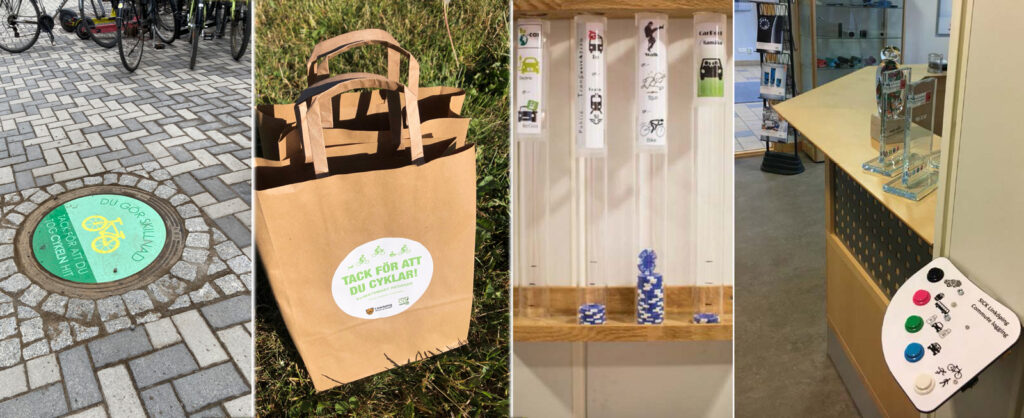
In Linköping’s Green Travel Plans, the measures specifically aim to make alternatives to driving easier in everyday life:
Together , these measures reduce daily car commuting year-round— especially when they target the routes where congestion is most acute.
Feel free to set deadlines for these measures, but also think long-term—behavioral change takes time. Since political support for sustainable travel can fluctuate, there is much to be gained by highlighting the health benefits of active travel, as well as what fewer cars on the roads mean for traffic safety and for a more people-friendly city.
The City of Linköping hasn’t limited its efforts to workplaces. Since 2021, it has been working on sustainable travel to schools in a similar way. This approach is called the “Green Travel Plan for Schools.” One school at a time is assessed: what does travel to the school look like, and what measures could encourage more children to bike or walk?
The summary of the “Green Travel Plans” approach presented here is the result of a collaboration in 2025 between Viable Cities, SKR (Swedish Association of Local Authorities and Regions), the City of Linköping, and a dozen Swedish municipalities as part of the Climate-Neutral Cities 2030 initiative, with the aim of facilitating, deepening knowledge of, and accelerating and broadening the implementation of the approach in the municipalities. The work was carried out in 2025 with funding from Vinnova as a feasibility study to prototype an accelerator designed to support the implementation, scaling, and dissemination of Green Travel Plans and other successful initiatives for climate-neutral and sustainable cities at the local level.
The City of Linköping, which has been working with Green Travel Plans since 2013, is a pioneer among municipalities and has inspired a number of other municipalities to launch similar initiatives, not least Lund and Östersund. Twelve cities at various stages of implementing Green Travel Plans have participated in the work and shared experiences and insights, concrete tools, methods, and documents with one another and with the project. These have been collected and compiled to inspire and guide other cities and their local stakeholders in their joint efforts to implement and further develop Green Travel Plans. Implementing green travel plans contributes to reducing climate emissions and a range of other positive effects, such as smoother daily travel, better accessibility, improved public health, inclusion, and gender equality. Evaluations of travel to areas with green travel plans show, among other things, reduced congestion and lower climate emissions over time. The travel plans have also created a clear forum for dialogue on sustainable transportation with employees, employers, and property owners.
To support the implementation, dissemination, and scaling of new working methods, knowledge resources such as guides, descriptions, and tools are needed. A key insight is that the value of these resources increases significantly when combined with opportunities to meet, discuss, and learn together with others who are working to implement similar working methods.


Viable Cities is a strategic innovation program with the mission of achieving climate-neutral cities by 2030, ensuring a good quality of life for all within the planet’s limits. The program is funded by the Swedish Energy Agency, Vinnova and Formas and coordinated by KTH.

Copyright © 2024 Viable Cities | Website Policy | Accessibility