Together for climate-neutral cities

Viable Cities is a strategic innovation program working towards the mission of Climate Neutral Cities 2030 with a good life for all within the boundaries of the planet.

New to the family? Here is a short introduction

What is Viable Cities all about? Here we offer a brief overview of what we do and why your contribution is so important in helping us achieve our mission – climate-neutral cities by 2030.

Green Travel Plans – The Path to Sustainable Daily Commuting

Most of the trips we take are short and routine. To work. To school. To the gym. When more people walk, bike, or take public transportation, everyone benefits: individuals, employers, society—and the planet. Green travel plans are a way to make everyday travel more sustainable. Here’s everything you need to know to get started.

The situation in cities leading the way

How is climate transition progressing in the 2030 cities? In their status reports, you can read about how the 48 cities are working together to transition to climate-neutral and sustainable cities.

Latest news

  • All calls
  • Accelerate
  • Current Sustainability
  • Alvesta
  • Arvika
  • reuse
  • Avesta
  • hospitality industry
  • Floor
  • Borås
  • Borlänge
  • The Swedish National Board of Housing, Building and Planning
  • C40
  • Capabilities
  • Chalmers
  • CHAMP
  • Cities Mission
  • CitiES2030
  • Climate Smart Cities Challenge
  • Climate Week New York
  • Climate-KIC
  • CoAction
  • Cop30
  • Covenant of Mayors
  • Debate
  • Digitalization
  • Drive Sweden
  • Driving Urban Transition
  • OTC
  • energy
  • energy communities
  • Energy Authority
  • Enköping
  • ERA-NET Cofund Urban Transformation Capacities
  • Eskilstuna
  • EU
  • Europe
  • European Viable Cities Day
  • Expo Dubai 2021
  • Falkenberg
  • Falköping
  • Formas
  • Research
  • Fossil-free Sweden
  • Fossil-Free Sweden
  • Gävle
  • Global
  • Gothenburg
  • Gotland
  • Greentopia
  • GTI
  • Håbo
  • Halmstad
  • Härryda
  • Helsingborg
  • Höganäs
  • Halmstad University
  • Höör
  • Horizon Europe
  • Indicators
  • InfraSverige
  • InfraSweden
  • innovation
  • IVL Swedish Environmental Institute
  • Järfälla
  • Jobs
  • squid
  • Karlskrona
  • Karlstad
  • Karlstad University
  • Climate
  • climate adaptation
  • Climate breakfast
  • Climate investment and financing
  • Climate Investment Plan
  • Climate Communities
  • Climate communication
  • Climate competitiveness
  • climate city contract
  • Climate City Contract 2030
  • Climate-neutral cities by 2030
  • climate change adaptation
  • Communication
  • Consumption-based emissions
  • Kristianstad
  • Kristinehamn
  • KTH
  • Royal Institute of Technology
  • progress report
  • Landskrona
  • Linköping
  • Linköping University
  • Foodstuffs
  • Local Climate City Contract
  • Lomma
  • Luleå
  • Lund
  • Lund University
  • M100
  • Malmö
  • Mariestad
  • land use
  • Civic engagement and involvement
  • Mjölby
  • mobility
  • Mobility and accessibility
  • Mörbylånga
  • government agencies
  • Nacka
  • business
  • National nodes
  • The Nature Conservation Society
  • Environmental Protection Agency
  • NetZeroCities
  • NetZeroCitiesEU
  • New European Bauhaus
  • Nordic Transition Partnership
  • transition arena
  • transition team
  • Örebro
  • Örnsköldsvik
  • Östersund
  • Östersund
  • PED
  • policy development
  • Positive Energy Districts
  • fairness
  • Research institute of Sweden
  • Resilience
  • Rethink Cities Summit
  • RISE
  • collaboration
  • Sandviken
  • Sharing Cities Sweden
  • Shiftsweden
  • Skellefteå
  • SMHI
  • Södertörn University
  • Urban planning and construction
  • State Agricultural University (SLU)
  • Stockholm
  • Stockholm Environment Institute
  • PROUD
  • Storytelling
  • Strängnäs
  • Governance and management
  • Sundsvall
  • Swedish Municipalities and Regions
  • Swedish University of Agriculture (SLU)
  • Sweden-US Green Transition Initiative
  • System demonstrators
  • Swedish Agency for Economic and Regional Growth
  • Tomelilla
  • Transport Authority
  • Transition Lab Forum
  • Transportation
  • Trollhättan
  • twin cities
  • Ukraine
  • Ulricehamn
  • Umeå
  • Umeå University
  • UN-Habitat
  • UniCities
  • Upplands-Bro
  • Uppsala
  • Uppsala University
  • Call for proposals
  • Calls for proposals
  • Emission-free construction machinery
  • Valencia
  • the 2026 election
  • Värmdö
  • Växjö
  • Viable Cities Insight
  • Vinnova
  • WWF
Green Travel Plans – The Path to Sustainable Daily Commuting
June 3, 2026

Most of the trips we take are short and routine. To work. To school. To the gym. When more people walk, bike, or take public transportation, everyone in society benefits: people, employers, society—and the planet. Green travel plans are an approach that makes it easier for more people to travel sustainably in their daily lives. Today, we’re launching a comprehensive resource on our website that makes it easy to get started.


Multi-level governance
June 3, 2026

The EU is currently working on designing its next Framework Program for Research and Innovation, FP10, which will run from 2028 to 2034. IQ Samhällsbyggnad and Viable Cities, together with other Swedish strategic innovation programs and stakeholders in the urban development sector, are now calling on the government to advocate for a European initiative focused on sustainable urban development and urban transition. The EU is currently working on shaping its next Framework Programme for Research and Innovation, FP10, which will run from 2028 to 2034.

Viable Cities International cooperation
June 2, 2026

The climate transition in cities is underway all over the world. Viable Cities’ international engagement is focused both on bringing insights back to Sweden and on sharing our own. In the near future, we will participate in the Driving Urban Transitions conference in Brussels, the sustainability conference in Hamburg, and the Innovate4Cities conference, which is being held in Africa—specifically in Kenya—for the first time.

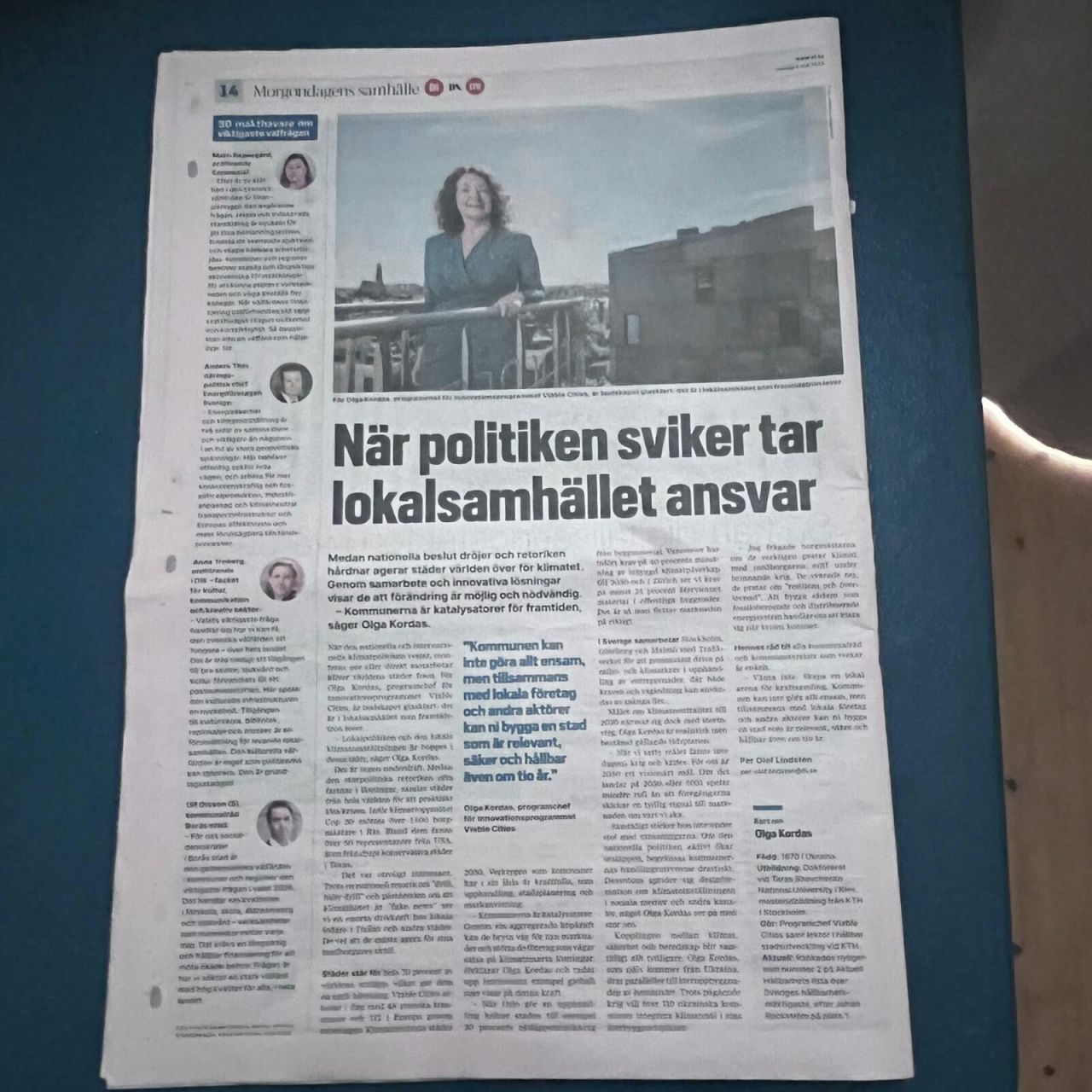
Image of a newspaper article
May 22, 2026

Cities are taking decisive steps to accelerate the climate transition. As national and international climate policies falter, are dismantled, or are directly opposed, cities around the world—in Europe and Sweden—are stepping up. Olga Kordas, program director at Viable Cities, describes this trend in an interview with Dagens Industri and notes that it is in our local communities where hope for the future lives on.

Luleå
Skellefteå
Örnsköldsvik
Sundsvall
Östersund
Gävle
Sandviken
Borlänge
Avesta
Arvika
Enköping
Trollhättan
Karlstad
Kristinehamn
Eskilstuna
Örebro
Uppsala
Järfälla
Värmdö
Stockholm
Mariestad
Härryda
Linköping
Mjölby
Borås
Ulricehamn
Gothenburg
Falköping
Växjö
Alvesta
Gotland
Falkenberg
Mörbylånga
Karlskrona
Helsingborg
Höganäs
Kristianstad
Tomelilla
Malmö
Höör
Landskrona

48 Swedish cities

48 Swedish cities are working together in Viable Cities' Climate Neutral Cities 2030 initiative. The map here gives a quick overview of all the cities and at each map pin you will find a link to the city's page, where you can read more about their work, current events and spy and apply their good examples.

Calendars

June 2026
October 2026
Oct 14
December 2026
Dec 04
04 December 1:00 p.m. - 3:00 p.m.
March 2027
Mar 17

Current calls for proposals

Calls for proposals are tools that research funders use to distribute their funds among stakeholders. Here you can see some current calls, but you can also explore more!

Oops, it was empty!

What are Viable Cities?

Viable Cities is a strategic innovation program with a mission to achieve climate-neutral cities by 2030, offering a good life for everyone within the planet's limits. In the Climate-Neutral Cities 2030 initiative—and with the Climate City Contract tool—the program is collaborating with 48 cities and six government agencies accelerate climate change mitigation. Viable Cities' mission-driven work is carried out in close collaboration with the European mobilization around "Mission Climate Neutral and Smart Cities 2030." Viable Cities is a strategic innovation program supported by a joint initiative of Vinnova, the Swedish Energy Agency, and Formas. The program is coordinated by KTH.