
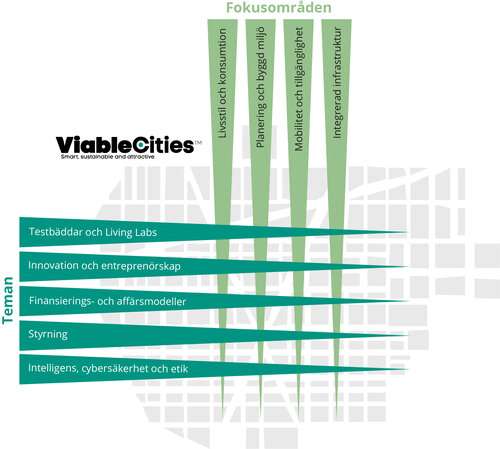
Viable Cities works with four focus areas and five themes that are linked through the program's activities and initiatives. This creates conditions for cross-linking and gives the program a clear structure for collaboration and development.
The program's focus areas are based on citizens' interests, drivers and needs and are implemented with clear citizen involvement. Lifestyle and Consumption, in combination with Planning and Built Environment, Mobility and Accessibility and Integrated Infrastructure are the largest sectors for energy use in a city. The focus areas are described in more detail below:
To make smart sustainable cities a reality and minimize the climate impact of individual choices, it is important to put people at the centre and understand their lifestyles and consumption patterns - as well as the energy use and emissions associated with them. Big data, mobile platforms, visualization and GIS-based tools present opportunities to empower citizens and strengthen societal participation in sustainability issues - provided that citizens are empowered to drive and engage in technological and societal developments.
Smart sustainable cities are resource- and energy-efficient neighbourhoods with close access to urban functions and ecosystem services that create attractive and livable environments, characterized by integrated renewable energy, energy storage, resource-efficient infrastructure planning, integrated intelligent building systems with respect to use. Viable Cities solutions can be applied for efficiency and flexibility in planning, for new urban development projects and for refurbishment of the existing building stock. Smart urban environments and good planning of the built environment and shared urban spaces will contribute to strengthening social cohesion, identity building, integration and reducing exclusion.
Smart sustainable cities need new solutions and ways of working that facilitate smart accessibility, mobility and travel, for example through carpooling and car sharing, intermodal transport, remote accessibility and virtual meetings. Advances in IoT are continuously taking place in terms of communication, connectivity, presence, low-cost sensors and computational capacity, and provide new ways of using information and payment services. With new actors and strong citizen engagement, it will be possible to overcome barriers caused by lack of coordination and suboptimal matching of supply and demand.
A prerequisite for smart sustainable cities is a high level of intelligence and integration within city infrastructure, such as energy conversion, electricity grids, district heating and cooling, ICT, water, transport, and waste. Digitalization is central to effective planning, investment and management of infrastructure and ecosystem services. At the same time, integration must allow sufficient flexibility from a socio-economic perspective where citizens and stakeholders work together for the best solutions.
Five concrete themes focus the activities and ensure that the development of technology and knowledge takes place with strong citizen involvement and with people at the center.
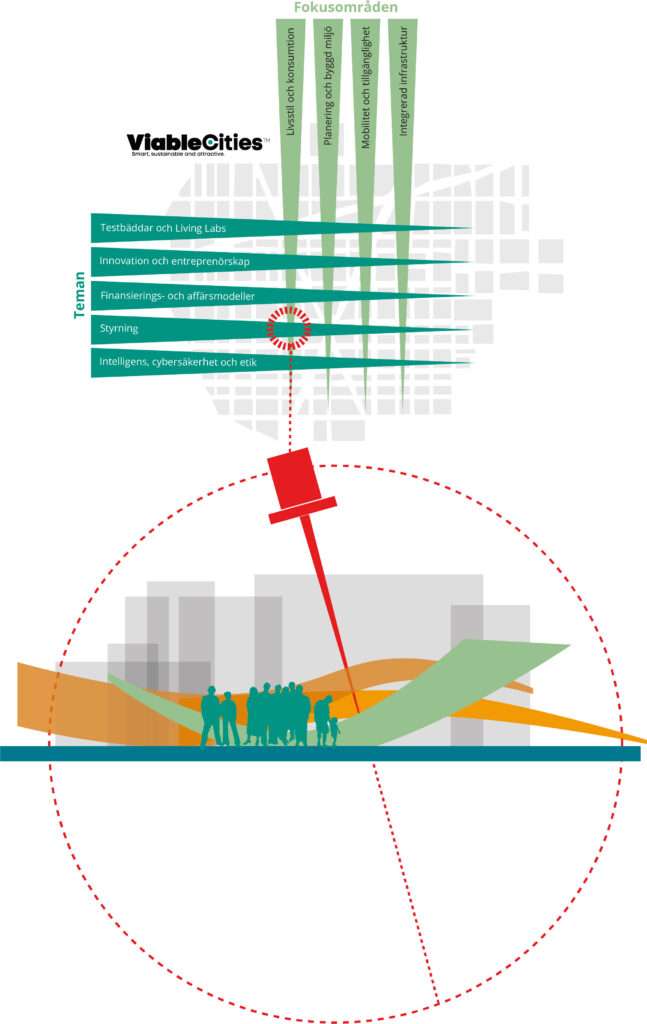
To achieve breakthroughs in the development of sustainable energy systems for cities, so that energy, climate and sustainable growth targets can be met, it is necessary that testing and evaluation involve citizens in everyday life. To this end, Viable Cities is establishing test beds1, including living labs2, to strengthen innovation and entrepreneurship. Issues related to funding and business models, governance, intelligence, cybersecurity and ethical issues must be observed.
Successful implementation of smart sustainable energy systems for cities is a requirement if we are to transform urban energy systems and dramatically reduce the climate impact of cities. Strong innovation ecosystems will need to be developed in Sweden to increase replicability and scalability of smart sustainable energy systems for cities while supporting commercialization and growth.
The transformation of the energy system will never be achieved by continuing with business as usual. Large-scale implementation of smart sustainable innovative solutions in cities requires a fundamental rethinking of business models, the creation of value chains, the introduction of new value calculation models with a broader set of social values, and new approaches to investment and financing.
Achieving the ambitious goals of smart sustainable cities requires the application of different governance methods, including strategic and collaborative planning, the integration of policy instruments and the involvement of key stakeholders in the decision-making process. The new urban planning models, such as 'eco-governance' in Stockholm, are of great importance for Swedish cities and have a high export value.
Smart sustainable cities are highly interconnected socio-technical systems that are increasingly dependent on electronic information and technology. It will be essential that the program can ensure collaborative learning processes between different actors and ensure that city platforms are built to connect different data sources and systems to create intelligent, robust and resilient solutions. Cybersecurity and ethical issues are central to the safe and fair functioning of smart sustainable cities systems.
Viable Cities is a strategic innovation program with the mission of achieving climate-neutral cities by 2030, ensuring a good quality of life for all within the planet’s limits. The program is funded by the Swedish Energy Agency, Vinnova and Formas and coordinated by KTH.

Copyright © 2024 Viable Cities | Website Policy | Accessibility